5 Reasons Green Beam Lasers Are Now the Industry Standard (And the ₹50,000 It’s Costing You to Stay on Red)
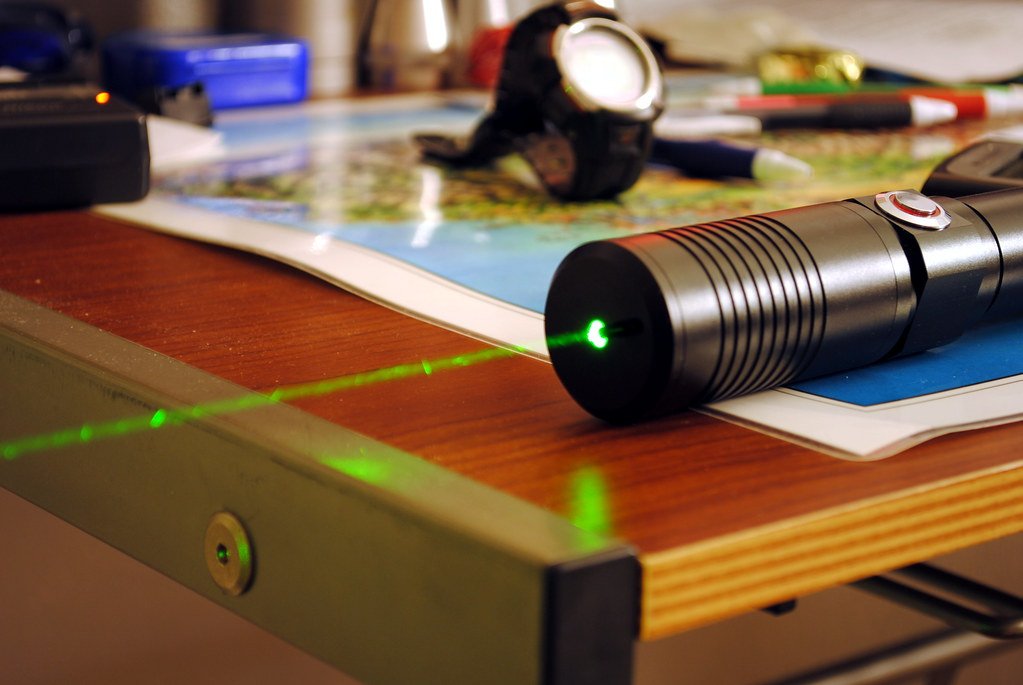
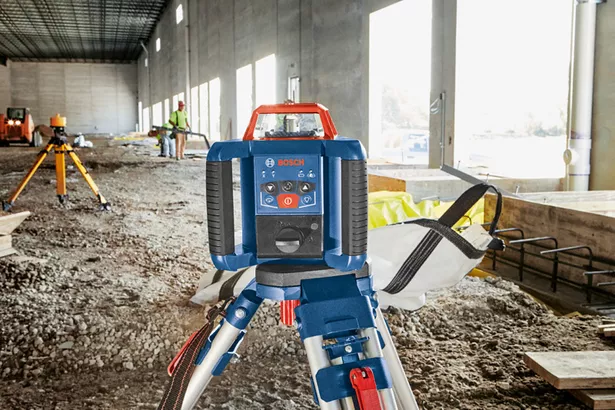
You’re on a rooftop. 11 AM. Direct summer sun. Your red beam is somewhere on that wall, you know it is, but you cannot see it. You walk over. Squint. Walk back. Adjust the detector. Try again.
That’s 35 minutes. You can’t bill them.
Meanwhile, the agency crew on the next plot set up in 9 minutes. Green beam. Same sun. No squinting.
Here’s the thing. This isn’t a story about spending more money on equipment. It’s about understanding why your current tool charges you a hidden tax on every outdoor project, and why more and more contracts now specifically require green beam capability in their equipment lists.
Let’s go through it point by point.
It’s Not a Preference. It’s Physics.
Before the five reasons, one foundation.
Red and green beams aren’t just different colours. Your eye processes them at different efficiencies, and the gap is significant.
The human eye is most sensitive to light at 555 nanometres. That’s the green wavelength. Red sits at 650 nm, near the edge of human visual range. At the same power output, a green beam appears 4x brighter to the naked eye than a red beam.
In a dark room, this difference doesn’t matter. On a construction rooftop in India in May, it’s the difference between a 10-minute setup and a 45-minute one.
That’s the mechanism. Everything that follows is a consequence of it.
Your Red Beam Is Invisible in Daylight, and Your Timesheet Shows It
A red beam laser starts losing naked-eye readability at ambient light levels above roughly 100 lux. Overcast morning indoors? Fine. Outdoor Indian summer site at noon? The beam is gone.
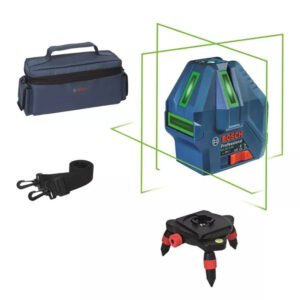
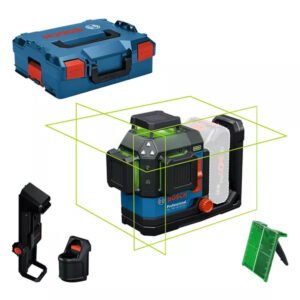
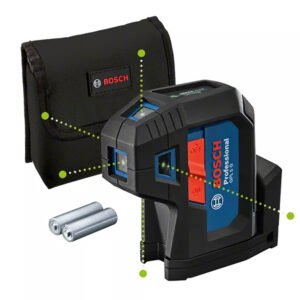
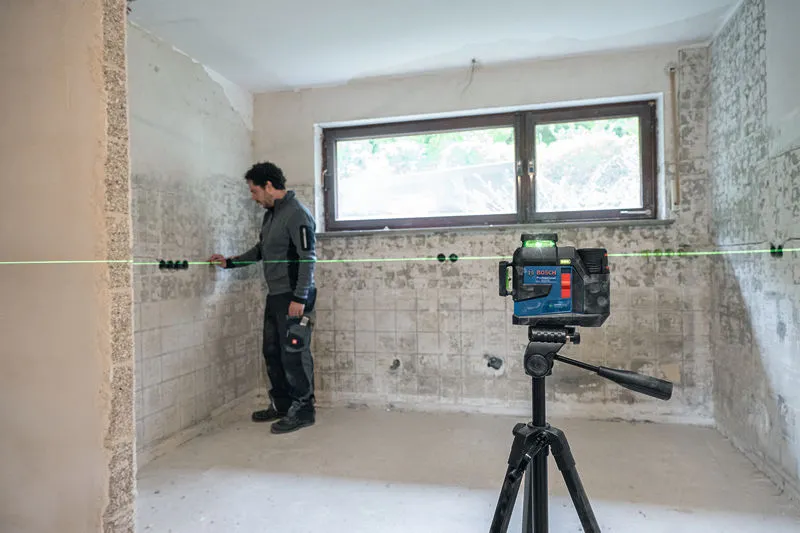
A green beam laser, like the Bosch GLL 3-80 CG or GPL 5 G, stays visible to the naked eye at ambient light levels up to 500+ lux. With a detector, it functions on sites where red beam operation has essentially stopped being practical.
Here’s what that actually costs you.
If you lose 35–45 minutes per outdoor session to visibility issues, and you’re billing at ₹2,500/hour, that’s ₹1,450–₹1,875 per project day that never makes it to your invoice. Across 30 outdoor projects per year: ₹43,000–₹56,000 in invisible lost billings.
That’s not a colour preference. That’s a revenue leak.
And it’s been running since you bought that red beam laser.
Faster Setups = More Billable Hours. The Numbers Don’t Lie.
The visibility improvement compounds into setup speed. And setup speed compounds into daily output.
In outdoor daylight conditions, a green beam laser consistently cuts reference point setup time by 35–40% compared to red beam. On a survey with 10–14 reference points, that’s 90 minutes to 2 hours recovered per project day.
At ₹2,500/hour: ₹5,000 per day. On a 5-day outdoor survey: ₹25,000 recovered.
Now rerun the upgrade math. A Bosch green beam laser is roughly ₹40,000–₹60,000 more than an equivalent red beam model at purchase. If it recovers ₹25,000 per outdoor survey project, it pays back the difference in 2 projects.
Most surveyors never run this calculation. They compare the price and stop. The agencies who run 40+ outdoor projects per year already figured this out, which is why their procurement lists have read “green beam, IP-rated, calibrated” for the last three years.
Green Beam Is Now a Contract Requirement, Not a Nice-to-Have
Here’s where it stops being a productivity conversation and starts being an access conversation.
Tenders from mid-to-large developers, PMCs, and infrastructure clients now increasingly specify green beam lasers in their equipment schedules. Some list specific series: Bosch GPL 5 G, GLL 3-80 CG. This isn’t arbitrary brand preference, it’s a client-side response to having surveys redone because of poor visibility conditions on outdoor sites.
They learned to specify the tool.
If you show up with a red beam laser and the contract says green beam certified, you don’t get the work. Not because your skill is wrong. Because the equipment box isn’t ticked.
Contracts worth ₹1 lakh–₹1.8 lakh per survey are going to surveyors who can check that box. Freelancers still running red beam tools are defaulting to ₹30k–₹50k residential and small-scale work, not because that’s their skill ceiling, but because their kit signals it.
You’ve probably sensed that “just buy a better laser” isn’t the complete answer. You’re right. The complete answer is: buy the specific tool the market is specifying, and understand exactly why it’s being specified.
What Clients See Is What They Believe About You
There’s a moment every freelance surveyor knows.
The client walks over while you’re setting up. They watch. And you can feel them forming an opinion about whether they hired the right person.
When a crisp green beam is readable on a wall 15 metres away in full afternoon sun, they relax. When you’re adjusting a detector for the third time trying to locate a beam that’s invisible in the light, they don’t.
This isn’t subjective. Visible precision signals authority. A client isn’t qualified to assess your angular deviation tolerance in the field. They assess your performance by what they can observe. A clean, readable green line on a surface 20 metres away is live proof that requires no explanation.
And here’s the part most surveyors miss: when the client can’t see the beam and asks, “Are you sure that reading is correct?” That’s not a technical question. That’s a trust question.
The right tool removes the question before it’s asked.
IP Ratings + Calibration Certificates, The Document That Protects Your Invoice
It’s not just visibility.
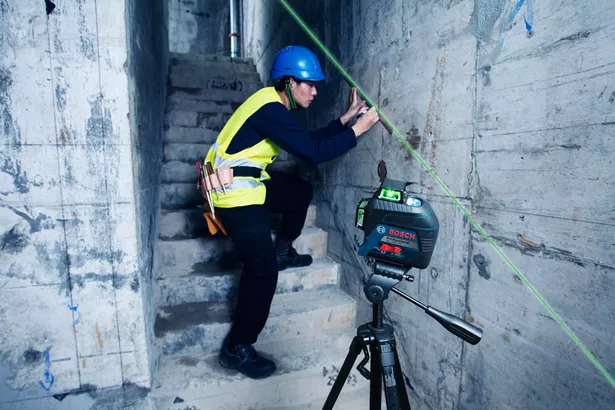
Bosch green beam lasers like GLL and GPL series carry IP54 or IP65 ratings. IP54 means dust-protected and splash-resistant. On a site in the pre-monsoon weeks, or any construction site in North India in summer where fine dust is constant, this is the difference between a tool that’s site-ready every day and one you’re treating like fragile cargo.
But the calibration certificate is where the real protection lies.
When you purchase through an authorized dealer, you get a factory calibration certificate with traceable accuracy documentation – ±0.1mm/m or ±0.08°, documented and verifiable. This isn’t just a piece of paper.
When a client’s quality auditor shows up mid-project and asks for proof that your equipment’s readings are valid, “I bought it a couple of years ago” doesn’t pass a compliance audit. A traceable calibration certificate does.
That document protects your payment.
It’s the difference between a clean sign-off and 2 weeks spent getting re-certified at your own cost while the client holds the invoice.
The Real Reason the Industry Is Moving to Green
It’s not just that green beam lasers perform better in sunlight, though they do, by a 4x visibility margin that’s rooted in the physics of human vision.
It’s that the projects worth chasing have started specifying tools by performance class. And the performance class built to survive Indian outdoor conditions, peak summer brightness, monsoon humidity, and construction site dust is IP-rated, calibration-certified, green beam.
The entry-level red beam laser wasn’t designed for this. It was built for indoor residential work, priced to hit a tender budget. It was never meant for 20-floor commercial sites in direct sun at 60,000 lux.
That’s not your fault. It’s what the specification sheet doesn’t say.
Most entry-level measuring tools are built to compete at a price point, not to perform at a field standard. The spec sheet shows beam distance in a dark room. It doesn’t mention what happens at noon in Hyderabad.
The Upgrade Isn’t a Cost. It’s a Removal.
A single green beam Bosch laser with IP54 rating and a traceable calibration certificate doesn’t just let you see your beam in daylight.
It removes the 35–45 minute outdoor visibility tax from every project day. It lets you bid on contracts that list green beam and ISO-certified tools as requirements. It provides the on-site credibility that comes from equipment the client recognises. And it gives you the documentation that survives a compliance audit.
The ₹50,000 invisible tax was always going to be paid. The question was whether you paid it in lost billings, or replaced it with a tool that earns it back in two projects.
Most surveyors stop at the sticker price comparison. The ones winning the ₹1.5 lakh contracts calculate the full cost of staying where they are.
Ready to see which Bosch green beam laser fits your project type and budget?
Browse the full range of Bosch green beam laser levels at www.civsol.in/shop – authorized dealer, factory calibration documentation included, warranty support available across India.
Recommended products
-
GLL 50-15 XG Professional
Original price was: ₹22,000.00.₹12,200.00Current price is: ₹12,200.00. -
GLL 18V-120-33 CG Professional
Original price was: ₹85,000.00.₹60,000.00Current price is: ₹60,000.00. -
LR 7 Professional
Original price was: ₹8,200.00.₹4,200.00Current price is: ₹4,200.00. -
GPL 5 G Professional
Original price was: ₹22,500.00.₹13,900.00Current price is: ₹13,900.00.